Standard Essential Patents in Solar Grid Integration: IEEE 1547, IEEE 2800, and Smart Grid Interoperability
A solar inverter shipping into the US market today has to satisfy IEEE 1547 for distribution-level interconnection. If it serves a bulk power system, IEEE 2800 applies as well. Sell the same unit in Europe and EN 50549 governs instead. Add remote management and IEC 61850 or IEEE 2030.5 enters the picture, each carrying its own communication protocol requirements.
Every one of those standards embeds patented technology that a compliant product cannot design around. That is what makes them standard essential patents, and it is why solar energy patents have become a licensing question rather than only an engineering one. As renewable penetration rises and grid codes tighten, the number of standards a single inverter must satisfy keeps growing, and so does the licensing surface underneath it.
Key Takeaways
- A grid-connected solar inverter typically implicates several standards at once: IEEE 1547 for distribution interconnection, IEEE 2800 for bulk power systems, EN 50549 in Europe, plus a communication standard such as IEC 61850 or IEEE 2030.5.
- SEP exposure in solar concentrates in inverter control logic: fault ride-through, anti-islanding detection, reactive power support, and grid-forming inverter control.
- Standards revision creates recurring licensing exposure. Each IEEE 1547 update adds inverter functions, which can bring new patent holders into scope for a product that was already compliant.
- Global deployment multiplies the problem, because a product sold across the US, EU, and Asia must satisfy regional standards that each carry separate SEP obligations.
- Watch the abbreviation. IEEE 2030.5 is widely called SEP2, meaning Smart Energy Profile 2.0, which is unrelated to standard essential patents.
What Standard Essential Patents Mean in an Energy Context
A standard essential patent protects technology that must be used to comply with a technical standard. Once an industry adopts that standard, any organization implementing it necessarily practises the patented invention, because compliance and infringement become the same act. SEP owners are generally obligated to license on FRAND terms, meaning fair, reasonable, and non-discriminatory.
Most familiar standard essential patents examples come from telecom and consumer electronics: cellular standards such as 5G NR and LTE, IEEE 802.11 Wi-Fi, Bluetooth, video compression standards including H.264 and HEVC, and interface standards such as USB and HDMI. For the mechanics of how SEPs are declared, valued, and licensed across those sectors, see “Understanding Standard Essential Patents in 2025” and “SEPs: Considerations, Challenges, and Best Practices”.
Energy is the sector where those same dynamics are arriving most recently, and where implementers are least prepared for them. An inverter manufacturer that has never negotiated a FRAND license may now hold obligations across half a dozen standards bodies.
Why SEPs Matter for Solar Grid Integration
Integrating solar into the grid is not simply a matter of connecting panels. It requires smart inverters, communication protocols, and advanced control systems, most of which depend on standardized methods that let solar contribute to grid stability, reliability, and efficiency. Companies deploying these technologies therefore work with SEPs whether or not they have identified them as such.
Tesla is a visible example. Products including Solar Roof, Powerwall, and Megapack rely on communication, smart grid, and energy management standards, with grid-tie inverters synchronizing voltage, frequency, and phase before injecting power into the grid. That synchronization behaviour is precisely where interconnection standards specify required functionality, and where the underlying patents sit.

Solar Inverter Standards and Their SEP Domains
Grid-connected solar photovoltaic systems depend on interoperability standards that define operational, safety, and communication requirements for distributed energy resources, covering solar panels, energy storage, and smart-grid interfaces. The table below maps the main solar inverter standards to the patent domains they implicate and to representative published patents in each area.

A Note on SEP2 and the Abbreviation Collision
IEEE 2030.5 is widely known in the energy industry as SEP2, short for Smart Energy Profile 2.0. In any document that also discusses standard essential patents, the abbreviation collides. SEP2 is a communication protocol specification for DER management. Standard essential patents are a licensing category. The two share three letters and nothing else, and conflating them in a licensing discussion produces confusion that is easy to avoid by writing IEEE 2030.5 in full.
Smart Grid Interoperability: Key Standards and SEP Hotspots
Patent exposure clusters in four areas across grid-connected solar deployments.
- Communication and data exchange: IEC 61850 for substation communication, DLMS/COSEM for metering, and IoT protocols including 5G, NB-IoT, and LoRa govern how data moves between distributed solar systems and the grid. SEPs here cover data encoding, message formats, security, and wireless communication.
- Inverter interconnection: IEEE 1547 defines how distributed energy resources connect to the distribution grid, while IEEE 2800 applies to bulk power systems. Patents in this space claim control logic for reactive power support, fault ride-through, and voltage regulation.
- Grid support and ancillary services: as inverters take on frequency regulation and voltage support, the control strategies enabling those functions carry their own patent coverage.
- Smart metering and analytics: metering platforms depend on standardized protocols for measurement, secure data transfer, and demand response, all patent-dense areas.
Grid-Forming Inverter Control: The Emerging SEP Frontier
Conventional grid-following inverters synchronize to an existing grid voltage and frequency reference. Grid-forming inverter control establishes that reference itself, letting inverter-based resources support a grid with little or no synchronous generation online. As renewable penetration climbs, this capability moves from optional to necessary, and IEEE 2800 reflects the shift toward dynamic grid support functions.
For IP purposes the significance is timing. Grid-forming control is being patented now, concurrently with the standards work that will make it mandatory. Implementers building it into products today may be building against claims that become essential tomorrow, which is a materially different risk profile from licensing a mature standard.
Licensing Complexity in Solar SEPs
When inverters, meters, and communication systems must comply with IEEE 1547, IEC 61850, or SunSpec Modbus, manufacturers are obligated to use the patented technologies embedded in those standards. Because those patents are standard essential, any compliant product necessarily practises them. Four factors compound the difficulty.
- Multiple patent holders: standards incorporate technologies contributed by different companies and research institutions, so a single inverter may require licenses from chipmakers, protocol developers, and grid technology firms simultaneously.
- Patent thickets: overlapping patents cover small variations on similar functionality such as voltage ride-through, anti-islanding detection, and secure communication. Determining which are genuinely essential is slow and legally contested.
- Negotiation burden: each SEP holder may require separate negotiation, agreement, and royalty payment, creating administrative overhead that delays product launches.
- Royalty stacking: with multiple holders, cumulative royalties can inflate costs and compress margins to the point where aggregate fees become unsustainable.
Global deployment multiplies all four. A product intended for worldwide sale must comply with IEEE standards in the US, EN standards in Europe, and national standards across Asia, each carrying its own licensing requirements.
Check out our Standard Essential Patents Services
Compliance Costs as Standards Evolve
IEEE 1547, IEEE 2800, and EN 50549 continue to evolve so that distributed energy resources interact with the grid safely as penetration rises. Those revisions improve grid stability. They also create recurring cost for manufacturers in three distinct ways.
Continuous Technology Upgrades
Each IEEE 1547 revision introduces additional inverter functionality: voltage and frequency ride-through, reactive power support, dynamic voltage regulation, and grid support functions such as frequency-watt and volt-var response. Manufacturers must redesign control algorithms, update embedded firmware, and sometimes upgrade hardware including controllers, sensors, and power electronics. Each cycle demands new R&D investment, testing, and certification.
Licensing Adjustments
New standard versions often incorporate technologies covered by different SEPs than the previous version did. Manufacturers must revisit licensing agreements and may need to negotiate with patent holders they have never dealt with. A product that is fully licensed today can require new licenses tomorrow purely because the standard moved.
Certification and Testing Expense
Every update to IEEE 1547 or related grid codes triggers re-certification of inverters and systems. Testing runs through accredited laboratories such as UL and TUV at substantial cost, particularly for manufacturers with broad product portfolios. Complying with US, European, and international standards simultaneously multiplies that expense. Compliance delays push back launches, and smaller companies that cannot absorb continuous certification cost tend to lose ground to larger manufacturers who can.
Hold-Up Risk and FRAND Licensing in Solar
Patent hold-up is the structural risk in any SEP regime. Before a standard is finalized, companies contribute patented technologies to the standard-setting process. After adoption, every manufacturer must use those technologies to comply. At that point the patent holder can raise royalty demands, because manufacturers cannot design around the patent without losing compliance.
FRAND licensing commitments exist to constrain that leverage. Standard-setting organizations require SEP owners to license on fair, reasonable, and non-discriminatory terms: royalties reflecting the value of the patent rather than the owner’s position, fees that do not make compliance prohibitive, and equal treatment across licensees.
In practice, three problems persist. What counts as fair and reasonable is frequently disputed and frequently litigated. Courts in the US, EU, India, and China interpret FRAND obligations differently, so a global product faces inconsistent legal exposure. And even where every individual license is FRAND-compliant, royalty stacking across many holders can still produce an unsustainable total.
Also read: Understanding Strategy on Standard Essential Patents
Patent Pools and Cross-Licensing in the Energy Sector
Two mechanisms reduce transaction cost. In a patent pool, multiple SEP owners contribute essential patents to a common pool, a licensing administrator offers manufacturers a single license covering all of them, and royalties are distributed by predefined rules. Manufacturers avoid negotiating dozens of separate agreements and reduce royalty stacking risk. Pools work well when most major holders participate and poorly when they do not, and valuing individual contributions fairly remains contested.
In cross-licensing, two or more companies grant each other rights to their SEP portfolios, often royalty-free where portfolios are comparable in scale. That reduces litigation among large inverter manufacturers and utilities, but it offers nothing to smaller companies without portfolios of their own to trade, who continue paying full rates.
The energy sector is earlier in this progression than telecom or media. For a detailed comparison of what happens when a pool consolidates successfully versus when it fragments, drawing on H.264 and HEVC, see “The IP Landscape of Video Codecs”.

Why Lumenci for Solar and Smart Grid SEP Analysis
Declared essentiality and actual essentiality are different things, and the gap between them determines what a manufacturer genuinely owes.
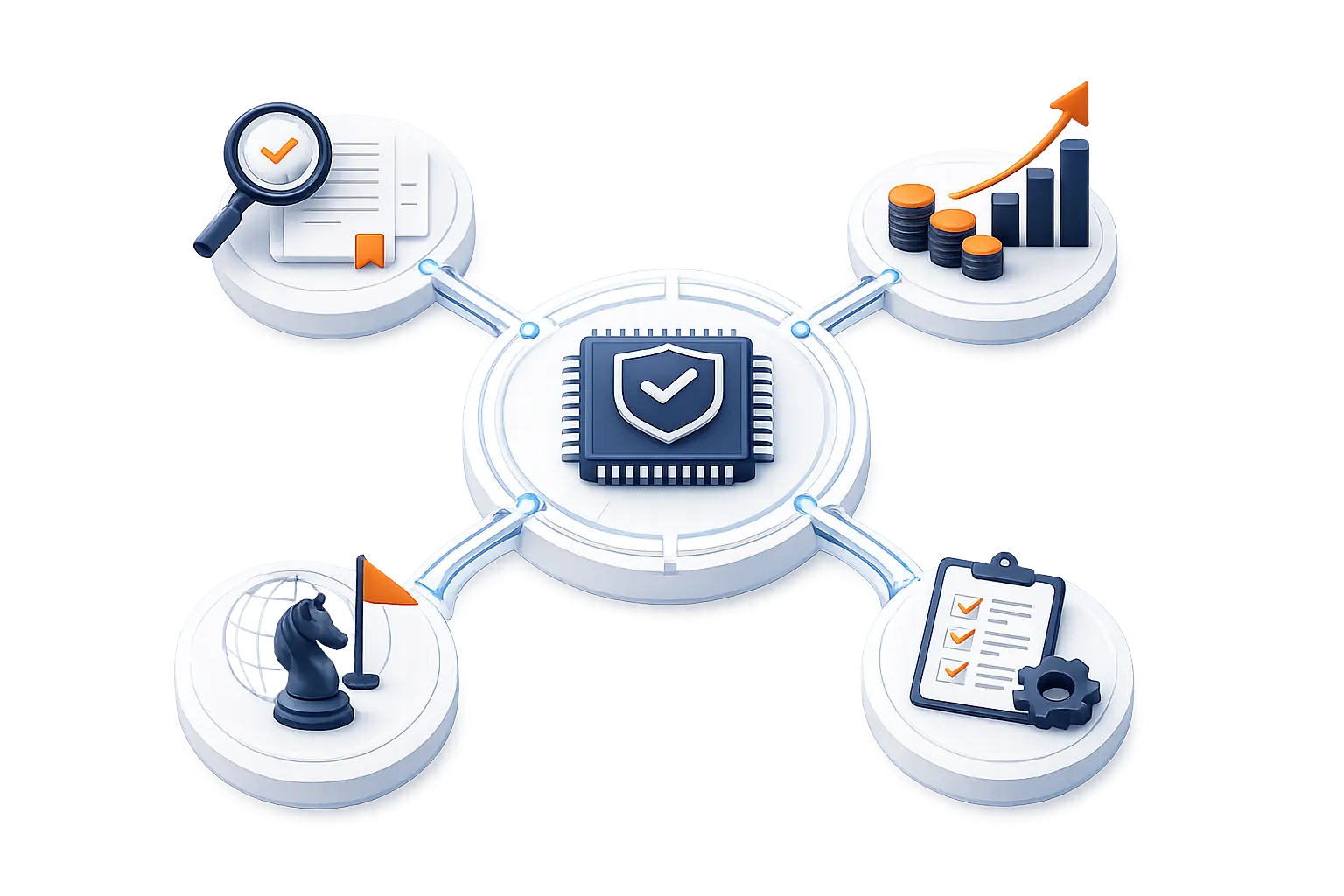
- SEP essentiality analysis: we map declared-essential patents against the text of IEEE 1547, IEEE 2800, IEC 61850, and related standards, and against the implementation as built.
Check out Lumenci’s SEP Services
- Power electronics and semiconductor depth: inverter control sits at the intersection of power electronics, embedded firmware, and semiconductor design, all areas Lumenci covers with domain engineers.
- Claim mapping for control-logic claims: ride-through, anti-islanding, and grid-forming claims recite behaviour under specific grid conditions, and mapping them requires reproducing those conditions rather than reading a datasheet.
Check out our Claim Charting Services
- FRAND and royalty exposure assessment: we help implementers understand where obligations attach across regional standards and product variants before a global launch commits them.
Talk to Lumenci about a solar, inverter, or smart grid SEP portfolio.
Contact Us
Conclusion
Standard essential patents cut both ways in solar grid integration. They are what makes interoperable interconnection possible at all, letting equipment from different manufacturers connect safely to the same grid. They also introduce licensing obligations that many energy-sector implementers are encountering for the first time.
The distinguishing feature of this sector is that its standards are still moving. Telecom SEP licensing matured around standards that stabilized years ago. IEEE 1547 and IEEE 2800 are actively revised, grid-forming control is being patented while the standards defining it are still being written, and regional codes diverge. That means licensing exposure for a solar manufacturer is not a fixed quantity to be assessed once.
For manufacturers, utilities, and policymakers, the practical implication is that SEP strategy in energy needs to track standards development rather than follow it. The grids being built now will be shaped by the intellectual property frameworks governing them as much as by the hardware.
Frequently Asked Questions
What is the IEEE 1547 standard?
IEEE 1547 defines how distributed energy resources such as solar PV, wind, and storage interconnect with the electrical distribution grid. It specifies operational, safety, and performance requirements including voltage and frequency ride-through, anti-islanding, and reactive power support
What is the difference between IEEE 1547 and IEEE 2800?
IEEE 1547 governs interconnection at the distribution level, which covers most rooftop and commercial solar. IEEE 2800 applies to inverter-based resources connecting to bulk power systems, addressing wide-area control and dynamic grid support at transmission scale.
Do solar inverters require standard essential patent licenses?
Frequently, yes. Compliance with interconnection and communication standards means implementing patented technology that cannot be designed around, which is what makes those patents essential. Exposure depends on which standards a product implements and which markets it ships into.
What is grid-forming inverter control?
Grid-forming control lets an inverter establish its own voltage and frequency reference rather than synchronizing to an existing grid signal. It becomes necessary as inverter-based resources displace synchronous generation, and it is an active area of current patent filing.
Is IEEE 2030.5 the same as a standard essential patent?
No, and the abbreviation causes real confusion. IEEE 2030.5 is commonly called SEP2, meaning Smart Energy Profile 2.0, a communication protocol for DER management. It is unrelated to standard essential patents despite the shared letters.
How does FRAND licensing apply to solar equipment?
SEP owners who contribute technology to standards such as IEEE 1547 commit to licensing on fair, reasonable, and non-discriminatory terms. The commitment constrains hold-up after a standard is locked in, though what qualifies as reasonable is often disputed and varies by jurisdiction.
Why do standards revisions create new licensing exposure?
Each revision can add functionality covered by patents from holders who were not implicated in the previous version. A product that was fully licensed against IEEE 1547-2018 may need additional licenses once it implements a later revision.
References
[1] IEC 61850 overview: https://www.pacw.org/iec-61850-an-overview
[2] Sandia National Laboratories, DER interconnection standards: https://www.sandia.gov/app/uploads/sites/273/2023/11/2023_Vermont_Webinar_Vartanian1.pdf
[3] NREL grid research: https://www.nrel.gov/grid/
[4] US DOE, grid modernization and smart grid: https://www.energy.gov/oe/grid-modernization-and-smart-grid